
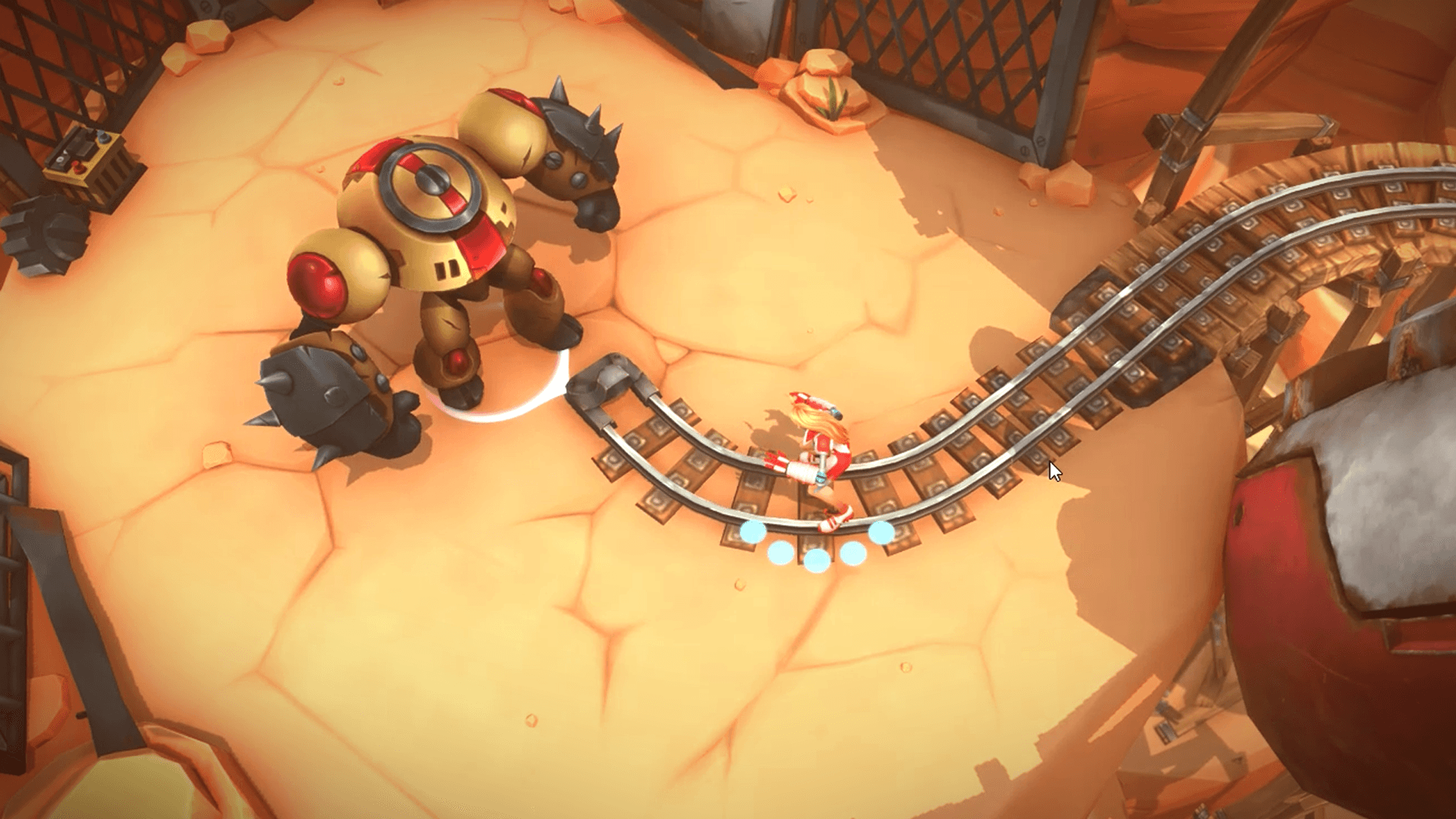
Before Shot One Fighters was a fighting game, it was a top-down isometric action game. We called it the brawler prototype internally because we wanted to draw a hard line between what we were building and the ARPGs that dominate that typical camera perspective. The idea was to take the free-flow combat philosophy from games like Batman Arkham Asylum and translate it into an isometric perspective. Flashy, quick, and rhythmic. Games like Anarchy Reigns and God Hand were just as much in the conversation. The through-line across all of those references was that combat should feel like a performance. Every exchange should have a tempo to it.
We were also exploring ideas outside of pure combat. Immersive sim elements where players could find ways around encounters entirely. Grabbing a battery and sneaking past a boss before it fully activated instead of fighting it head-on. We never built that system out, but it was part of the design conversation early on. The prototype was a single-player, story-driven game built around Volley as the player character. It never shipped, but it eventually grew into something else entirely.
Stamina as a Decision
Volley's stamina system was built around capsules. You had a set number of them, they regenerated slowly, and they got consumed when you dashed or empowered a heavy attack. The idea was to give players a visible, countable resource rather than a draining bar. You could look at your capsules and know exactly how many big moves you had left before you needed to back off.
Items could increase the number of capsules or speed up regeneration. Enemies could reduce both. That created a push and pull where your resource economy wasn't static. The battlefield could change how aggressive you were allowed to be.
The Combo System
Light attacks were your bread and butter. Quick, repeating hits at slightly varied intervals that ended with a heavier finisher. They were primarily springboards into the heavy attacks, but they also fed the stun mechanic, so there was always a reason to stay in someone's face.
Heavy attacks were where things got interesting because each one had an additional effect attached to it. Knockups, knockbacks, charged variants that consumed stamina capsules for more damage and stronger effects. The charging was interruptible. You could hold the input and release whenever you wanted, which meant you were constantly making micro-decisions about how much resource to commit.
We also built a delayed input system. If you paused between inputs in a string, you'd trigger an alternative attack. So L-L-L gave you one sequence, but L-L-pause-L gave you something completely different. Volley had a devastating knee kick off that delayed third input that would send enemies into walls. The goal was to make the combo system feel like it had hidden depth without requiring a move list to navigate.
Feedback That Mattered
Every enemy had a stun meter on top of their health bar. Constant incoming damage filled it. Stop hitting and it reset. Once it filled, the enemy locked into a stagger state and you could trigger a hype finisher off a contextual input.
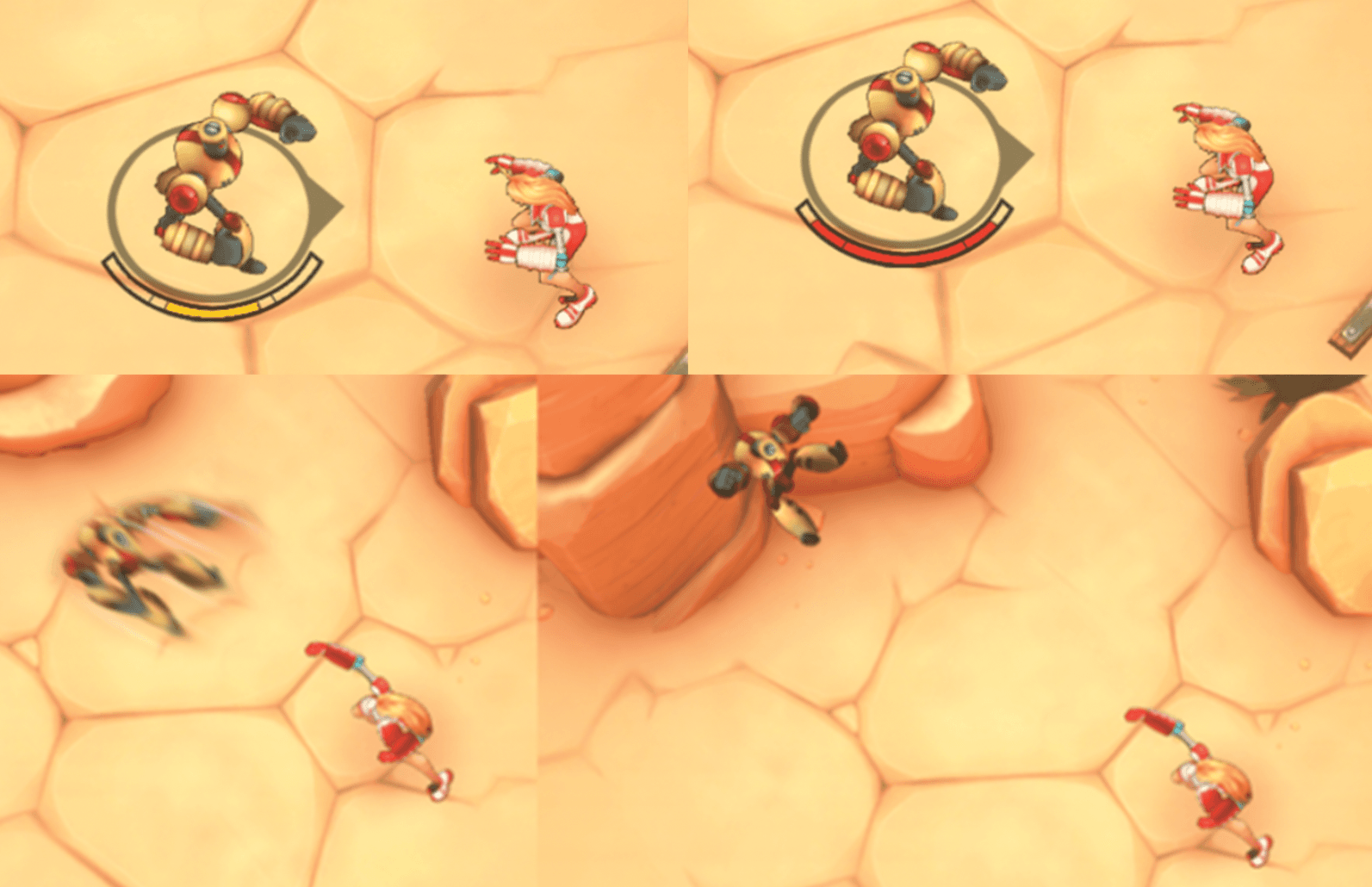
The knockback system layered on top of that. Certain enemies could be launched away from the player at force. If they hit a wall before the knockback resolved, they'd slam into it and get stunned. If they hit another enemy, both took damage and both got stunned. That collision system meant positioning was always a factor. You weren't just thinking about your combo strings, you were thinking about where bodies were going to end up.
Why We Moved On
We're proud of what we built here. The prototype played well and the combat had a feel to it that I still think holds up. But when the roguelite fighting game idea came together, it grabbed us in a way this didn't. Not because the brawler was lacking. More that the fighting roguelite concept felt like genuinely uncharted territory. There aren't many games doing what we're trying to do, which means there aren't established expectations to design around. That's a risk. But as a designer, that kind of blank canvas is hard to walk away from. Most of what we built carried over. The character assets, the rigs, a lot of the foundational work transitioned cleanly into the fighting game. Some animations didn't make the jump, but nothing was wasted. We made the call and moved on.
Subscribe to 𝕾𝖍𝖎𝖓 𝕽𝖎𝖌𝖒𝖆𝖓
Get the latest posts delivered to your inbox. No spam, unsubscribe anytime.
Latest
More from the site
Shin Rigman
Personal
Generative Rendering and the Future Nobody Asked For
On March 16, 2026, Nvidia CEO Jensen Huang unveiled DLSS 5 at the ‘GPU Technology Conference’. The internet reacted poorly, to put it lightly. Later, when Tom's Hardware pressed him about the backlas
Read post
Shin Rigman
Freelance
Splicer Dog
#Freelance
Read post
Shin Rigman
Freelance
Neon Rider X Steelseries
I produced a promotional animation showcasing limited edition SteelSeries products featuring the Neon Rider character. This was a solo effort where I handled everything from rigging and animation to
Read post